
Affiliate bridge page testing begins by identifying where the reader’s journey stops. A page can generate many outbound clicks and still send the wrong people to an offer. It can also appear unsuccessful because reporting windows differ or because a destination changed. Rewriting the headline before checking those possibilities makes the diagnosis harder.
Quick Answer: Verify the link and measurement first, then compare the incoming promise, the bridge page’s explanation, and the actual offer. Test one material hypothesis at a time. Judge results using qualified behavior and mature referral data, not clicks alone.
This is an original diagnostic framework, not a case study of measured conversion gains. The numerical examples are hypothetical. It builds on our guide to structuring a SaaS affiliate bridge page and focuses on evaluating a page that already exists.
Affiliate bridge page testing starts with the journey
Write down the sequence a reader actually encounters: source post or advertisement, bridge page, outbound link, vendor landing page, account or trial flow, and purchase. Save the promise made at each stage, including any price, feature, or eligibility qualification.
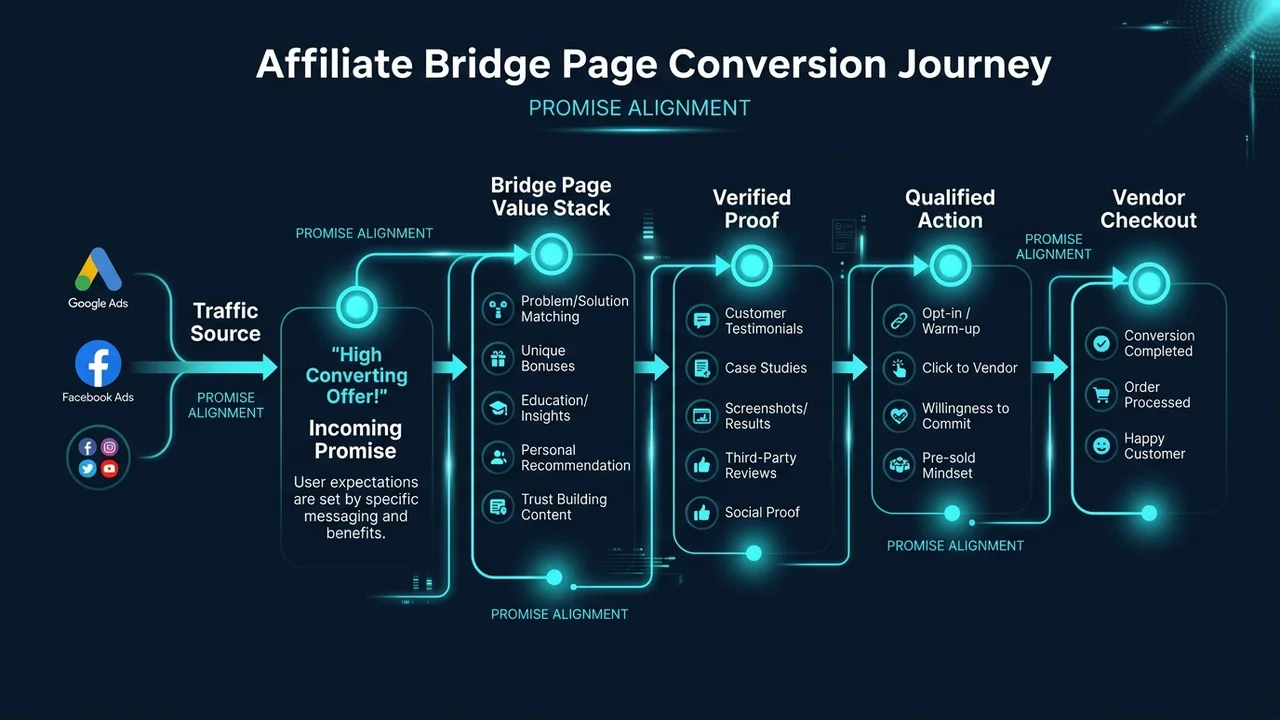 Figure 1: Full user journey mapping: from traffic source and incoming promise to value stack, verified proof, and qualified vendor checkout.
A mismatch is often visible without a large analytics sample. An article promising a beginner setup can lead to a bridge page discussing enterprise reporting. A button saying “view pricing” can land on a generic homepage. Those are concrete problems because the next page fails to continue the reader’s expected task.
Review the page on the devices your audience uses. Check whether the recommendation, disclosure, limitations, and next action remain understandable. A technically working link is not enough if the user cannot tell what they will find after selecting it.
Check instrumentation before interpreting performance
Verify that the outbound destination is the intended one and that the approved affiliate parameters remain intact through redirects. Use the partner platform’s permitted testing method; do not create a self-referral or purchase simply to generate a conversion event.
Define the denominator for each metric. Outbound click rate might be outbound clicks divided by eligible page sessions, while a partner conversion rate may use a different counted population. Write the definitions next to the report instead of comparing similarly named percentages as though they were identical.
The affiliate funnel tracking guide provides context for organizing tracking. Also consult the actual platform documentation for the events and attribution settings you use. Do not infer user-level attribution from aggregate counts alone.
Sort the problem into four hypotheses
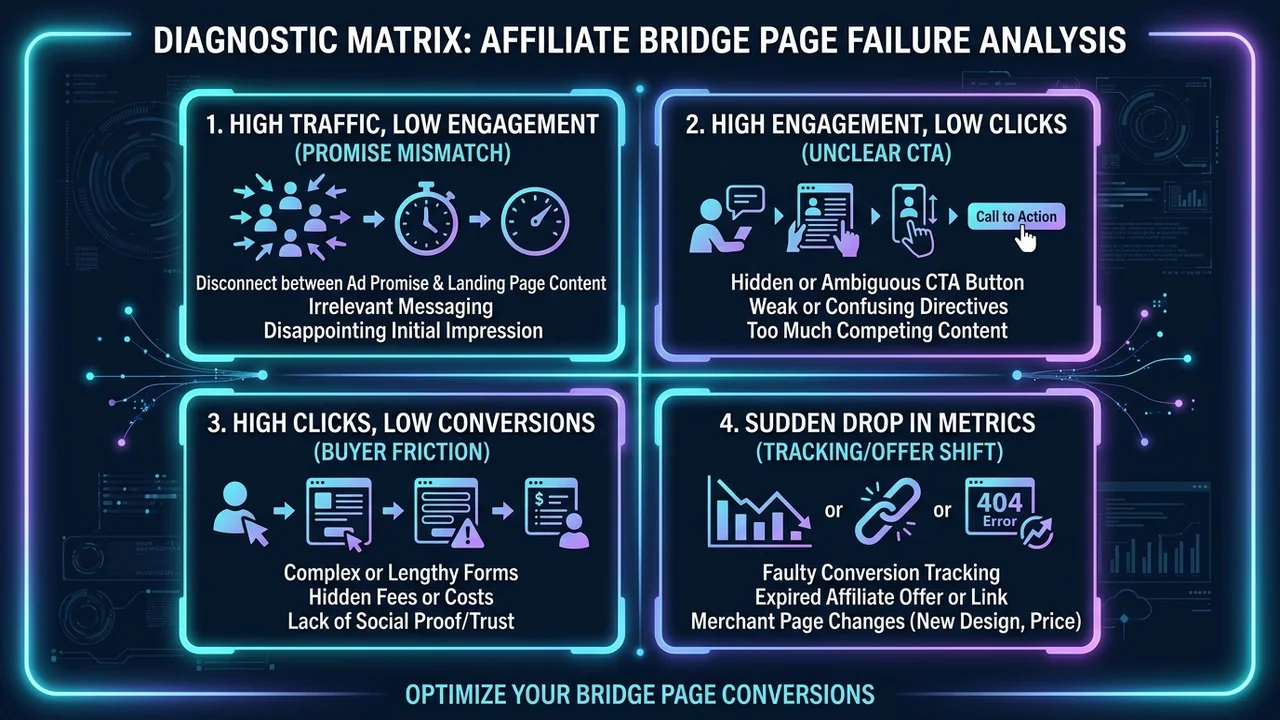 Figure 2: Four-quadrant CRO diagnostic matrix identifying core conversion dropoffs: promise mismatch, unclear CTAs, buyer friction, and tracking shifts.
| Symptom | Possible explanation | First check |
|---|---|---|
| Many arrivals, little engagement | Incoming promise does not match the page | Compare source copy with the first screen |
| Readers engage but rarely leave | Recommendation or next step is unclear | Ask a reader what the button will do |
| Many outbound clicks, few tracked actions | Low buyer readiness, destination friction, or measurement limits | Inspect offer fit and tracking definitions |
| Strong past results, recent drop | Changed traffic mix, offer, page, or reporting delay | Compare dated changes and mature cohorts |
The table suggests hypotheses, not conclusions. Several causes can occur together. Start with the explanation you can test most directly, especially broken destinations and factual mismatches.
Avoid turning every symptom into a copywriting problem. If visitors cannot use the product in their situation, a stronger headline may increase clicks without improving their decision.
Inspect the promise, proof, and next step
The promise should name a problem the destination can help address. Keep it specific enough to be checked. “Compare two approaches to briefing writers” is easier to honor than “transform your entire business.”
The proof should match the type of claim. A documented workflow can support an explanation of how the process works. It does not automatically support a claim about revenue or rankings. If the page is based on public documentation, say so rather than presenting it as a product test.
The next step should describe the action accurately. Viewing a plan, starting an evaluation, and applying to an affiliate program are different actions. Confusing buyers with prospective affiliates can make a page look busy while serving neither group well.
Add a short “not suitable if” section where it helps qualification. Readers who need a simpler solution should be able to leave with a useful decision, not feel that every path points to the same paid product.
Write one test hypothesis before editing
Use this test card:
| Field | Example |
|---|---|
| Observation | Readers ask whether the tutorial requires a paid plan |
| Hypothesis | Missing plan context sends unsuitable readers onward |
| Change | Add verified plan requirements before the CTA |
| Primary measure | Qualified next-step behavior using a fixed definition |
| Guardrail | No increase in misleading or support-related feedback |
| Review window | A period chosen before the test, allowing for referral delay |
| Decision | Keep, revise, revert, or collect more evidence |
This example is illustrative. It is not a claim that adding a plan table will improve conversion. Its value is that the change and the expected mechanism are explicit.
Keep other major elements stable during the test. If you change the headline, offer, traffic source, and button together, you may improve the page but will have difficulty explaining which change mattered.
Use low-volume evidence carefully
A small publisher may not have enough traffic for a reliable split test. In that case, combine structured reader feedback, session-level diagnostics where appropriately available, and a documented before-and-after observation. Label the evidence as directional rather than statistically conclusive.
For example, suppose ten readers in one period generate one approved referral, and ten in another generate two. The percentages differ sharply, but the sample is too small to treat the second version as a dependable doubling of performance. Preserve the raw counts.
Account for timing. Pending referrals and delayed approvals can make a recent period look worse than an older one. Compare cohorts with similar time to mature, and report unresolved transactions separately.
Do not keep testing indefinitely without a decision rule. If the evidence remains thin, prefer the version that explains the offer more accurately and is easier to maintain. You do not need to claim a conversion win to improve clarity.
Keep editorial quality inside the test
Google’s helpful content guidance emphasizes useful, original value and avoiding exaggerated headings. For a bridge page, apply that by making the page useful before the outbound click: explain the choice, evidence, limitations, and relevant alternative.
Do not remove caveats or disclosures merely because doing so might increase clicks. A click gained through misunderstanding is not a sound objective. Measure whether the page prepares a suitable reader for the next decision.
Diagnostic checklist
- Verify the actual link, redirect, and intended offer.
- Write down the promise at every stage.
- Define the denominator and attribution window for each metric.
- Separate buyer education from affiliate recruitment.
- Identify one hypothesis and one material change.
- Preserve raw counts and account for delayed approvals.
- Keep disclosures, limitations, and alternatives visible.
- Record the decision even when the result is inconclusive.
Frequently Asked Questions
Are more outbound clicks always better?
No. Extra clicks can come from curiosity or confusion. Evaluate whether the page sends appropriately informed readers to a relevant next step, then compare mature downstream results.
Should I rebuild the whole page?
Start with a specific diagnosis. A complete rebuild may be justified when the purpose is wrong, but it obscures learning when a broken link or mismatched promise is the actual issue.
Can I test without enough traffic for an A/B experiment?
Yes, using reader feedback and structured observations. Be explicit about the limits. Improving accuracy and usability does not require presenting a small sample as a statistically established conversion lift.
When should I change the offer instead of the page?
When the audience’s recurring needs do not fit the offer, or the product no longer supports the promised task. A better explanation cannot create product fit where it is absent.
Improve the decision the page supports
Use the affiliate platform comparison guide to reassess fit if the destination is the problem. Otherwise keep the offer stable and test the clearest explanation of the next step.