
A Semrush affiliate program review is most useful when it separates interest in marketing from intent to buy marketing software. Someone asking what SEO means is not in the same position as an agency replacing a reporting workflow. Both may read your content, but only one may be ready to evaluate a paid platform.
Quick Answer: Consider Semrush promotion when you can identify a specific buyer, recurring marketing task, and suitable product. Build content around that decision. Treat advertised commission as a conditional offer, and measure approved referrals rather than assuming every click or trial creates revenue.
This is a desk review based on public program information checked on September 27, 2026. The editorial framework and examples below are our recommendations, not observed campaign results. MoltyFlywheel may earn commissions through affiliate links on internal destination pages.
Semrush affiliate program review: establish the commercial facts
The official program page states that the program operates through Impact. It advertises up to $450 per sale and $10 per trial activation, with rewards depending on product and partner tier. It also lists several product families, so one headline amount does not describe every referral.
The page prohibits self-referrals and misleading promotional content, and requires affiliate disclosure. These facts were checked on September 27, 2026. Verify the actual product offer, eligibility, attribution, and payment schedule in your approved agreement before projecting revenue or buying traffic.
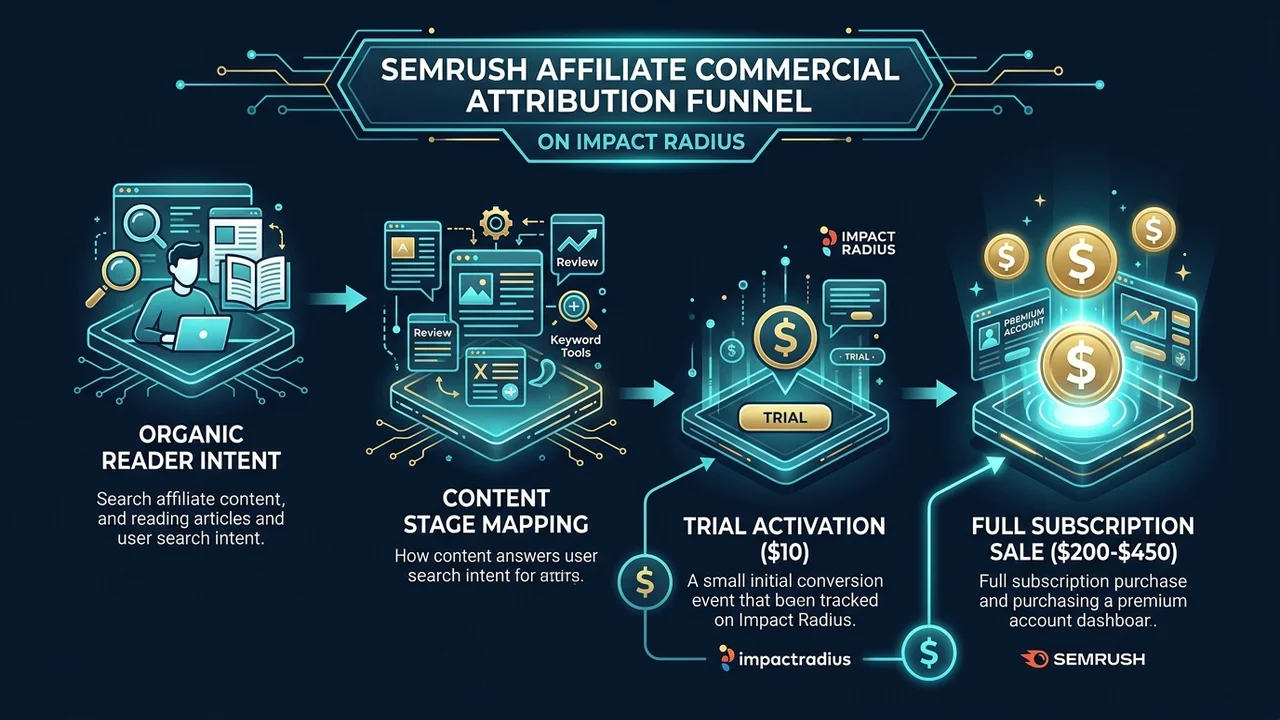 Figure 1: Semrush commercial referral funnel on Impact Radius: mapping search intent to trial activation ($10) and full subscription sales ($200–$450).
Begin with the affiliate program qualification framework if you have not yet defined your audience. A payout comparison cannot replace that earlier decision.
Identify the task before the tool
Interview the reader you want to serve, even if that means reviewing past audience questions rather than conducting formal interviews. Look for a repeated task, a current workaround, a cost of delay, and someone with authority to approve a change.
An agency account manager might need a clearer way to communicate progress to clients. A content lead might need to prioritize topics across a website. A local business operator might need a manageable process for location-specific marketing. These are editorial starting points, not claims that every available plan solves every problem.
For each starting point, check the current official product documentation before writing a demonstration. Name the relevant product or plan instead of treating a large software brand as one undifferentiated subscription. If a feature is outside the evaluated plan, disclose that before the reader follows the recommendation.
Map content to the decision stage
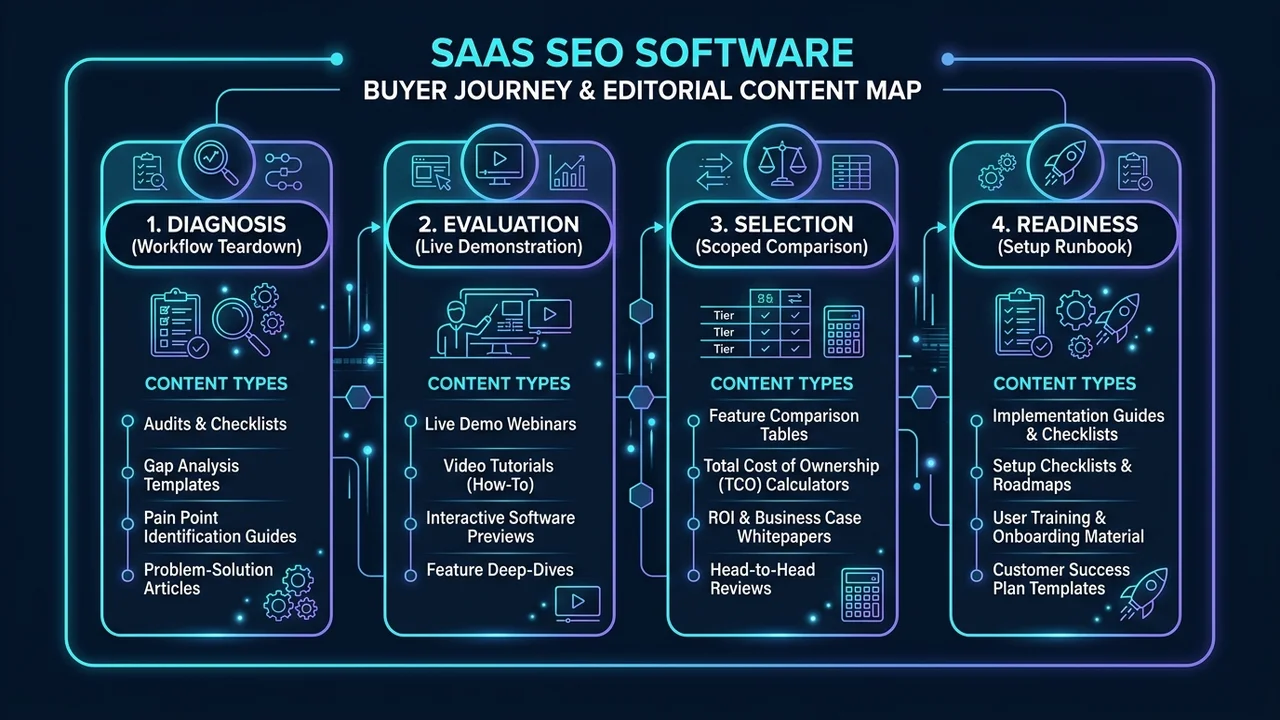 Figure 2: Four-stage content mapping framework: aligning editorial formats with reader diagnosis, evaluation, selection, and readiness.
Use an intent map to keep each article focused:
| Stage | Reader question | Appropriate article | Next step |
|---|---|---|---|
| Diagnosis | Why is this task taking so much time? | Workflow teardown | Identify the bottleneck |
| Evaluation | What would a better process look like? | Documented demonstration | Compare with the current method |
| Selection | Which product covers my actual use case? | Scoped comparison | Verify plan and limits |
| Readiness | Can my team adopt this successfully? | Setup and handoff checklist | Run a bounded trial |
Avoid sending every stage to the same aggressive purchase message. An educational article can link to a demonstration rather than directly to an affiliate destination. That intermediate step is useful when the reader still needs to understand the task or the effort of adoption.
This map is an editorial proposal. It does not establish conversion benchmarks or claim that a specific content sequence will outperform another. Test it against the questions and actions of your own audience.
Create a demonstration with an inspectable result
A demonstration should have a starting artifact, a goal, and an output someone can judge. Use a site you own or have permission to analyze. Describe the input date, the product scope, and what you changed manually after the tool produced its result.
For a prioritization example, the output might be a shortlist of pages with reasons for reviewing each one. The useful part is the decision logic: why one page deserves attention now and another can wait. A screen recording with many dashboard tabs is less helpful if it never produces that decision.
Keep claims proportional to the evidence. Showing that a workflow produced a clearer task list supports a claim about organization. It does not establish a ranking increase or a revenue effect. If results arrive later, update the article with dates and relevant competing explanations.
Our bridge page guide explains how to carry that context into the next stage of the reader’s journey. The destination should continue the same promise, not abruptly switch to a different problem.
Track a referral funnel without confusing its stages
Create separate counts for eligible article sessions, unique outbound clicks where measurable, tracked trials, tracked purchases, approved commission, and actual payments. Record the reporting window and acknowledge that the analytics platform and partner platform may not identify the same people or use the same attribution rules.
A hypothetical example illustrates the distinction: an article receives 800 relevant visits and 40 outbound clicks. The partner dashboard later records three eligible trials and one purchase. Those are different events; adding them together as four customers would misstate the result. The example is not a Semrush benchmark.
When information is missing, label it as unknown. A purchase outside the attribution window might not appear as your referral; a clicked link may never become a trial. You cannot infer individual behavior from aggregate counts alone.
For financial planning, use mature cohorts and the approved commission actually associated with them. Divide the content’s maintenance and production costs by those outcomes only when the sample is meaningful enough to inform your decision. A single successful referral is encouraging evidence, not a stable conversion rate.
Set limits on the recommendation
Some audiences need a simpler process before a larger platform. A business without an owner for marketing work may struggle to use another subscription consistently. A one-time question may be better served by a focused research session than a long-term tool commitment.
Name those cases in the article. Include a section explaining the work the reader must still do: interpreting data, choosing priorities, checking recommendations, and maintaining content. Software access does not create the operating discipline required to benefit from it.
Keep the review maintainable. Assign a date for checking product names, links, account terms, and screenshots. If the offer changes, update the commercial section before continuing to distribute the article.
Pre-campaign checklist
- Choose one buyer role and one recurring task.
- Verify the relevant product rather than the brand alone.
- Record the current offer in the approved partner account.
- Show a real demonstration or clearly label desk research.
- Explain who should delay or reject the purchase.
- Separate clicks, trials, sales, approvals, and payments.
- Schedule a terms and screenshot review.
Frequently Asked Questions
Does every sale earn the advertised maximum?
Do not assume so. Use the product and partner terms that apply to your account. A maximum is not an average, and an average from another publisher would not predict your own results.
Should I target beginners or experienced marketers?
Target a clear task and readiness level. Beginners may need diagnosis and education; experienced operators may need a scoped product comparison. A single article should make its intended reader obvious.
Can I call a trial a successful referral?
You can report it as a tracked trial when the platform records it. Keep that distinct from a paid customer and an approved commission. Precise labels make campaign decisions more reliable.
What makes the first article worthwhile?
It helps the reader complete a decision even without purchasing. A narrow demonstration with visible limitations is more defensible than a broad recommendation based on a commission headline.
Build the decision before the campaign
Use the Semrush program page as a route to the official offer. Start with one buyer problem, publish one useful demonstration, and expand only after you understand the quality of the resulting audience.