
An AI agent pilot scorecard should measure completed work that a reviewer accepts, not the number of actions an agent performs. A workflow can call tools successfully, produce a polished response, and still miss the assignment. Scaling that workflow increases activity without establishing reliability.
Quick Answer: Define an accepted outcome, test representative tasks under bounded permissions, and track intervention, total cost, and failure severity. Separate technical execution from task success. Expand only the scope that has evidence behind it, while retaining a clear way to stop and recover.
This is an original pilot framework. The examples and thresholds are illustrative proposals, not production benchmarks or claims about any particular model. Use it to design a limited experiment for a task you already understand.
Define the AI agent pilot scorecard’s unit of work
A task should have a beginning, an accepted output, and a completion condition. For an editorial assistant, that could be a sourced brief saved in the correct location with unresolved claims flagged. “Help with marketing” is too broad to evaluate consistently.
Write down what the agent may do and what remains outside scope. For a draft assistant, reading approved sources and saving a draft may be allowed, while publishing and messaging external recipients remain separate actions. The pilot should test the bounded assignment rather than an unrestricted interpretation of it.
The human approval workflow explains how to connect a reviewer to a particular release version. For a pilot, use the same principle: acceptance should identify the artifact that was actually reviewed.
Choose a representative task set
Include routine tasks, incomplete inputs, conflicting evidence, unavailable dependencies, and cases that should result in a request for clarification. An agent that completes easy examples but invents missing facts is not ready for more responsibility.
Keep part of the task set out of prompt tuning. Save the task specification and acceptance rubric before each run. If the assignment changes halfway through, record a new version rather than comparing the results as though the conditions were identical.
Run the existing human or automated method on comparable tasks. Without a baseline, you cannot tell whether the agent reduced work or simply moved it from execution into supervision and repair.
Separate execution success from task acceptance
Technical success means the workflow ran according to its machinery. Task acceptance means the result meets the assignment. Maintain both fields because their disagreement is often the most useful diagnostic signal.
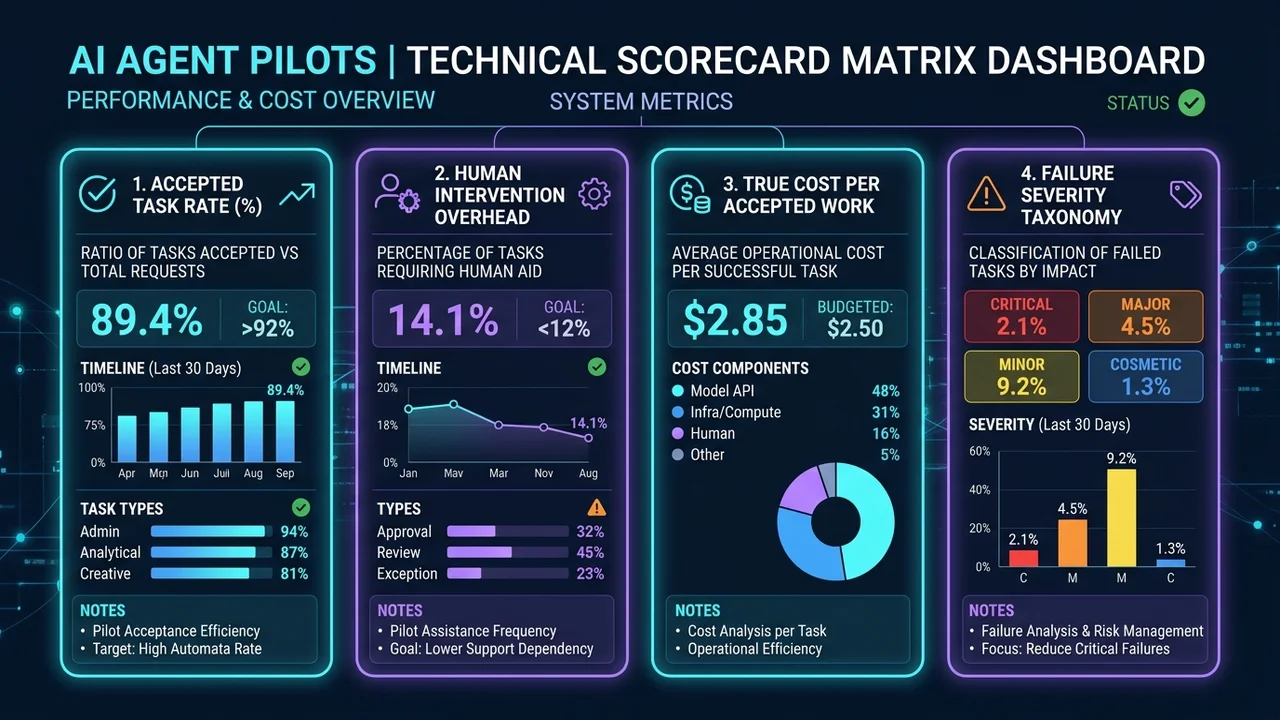 Figure 1: Core evaluation metrics dashboard: tracking accepted task rate, human intervention overhead, cost per accepted outcome, and failure severity classification.
| Metric | Definition | What it reveals |
|---|---|---|
| Accepted task rate | Accepted tasks divided by attempted tasks | Whether outputs meet the assignment |
| Intervention rate | Tasks needing unscheduled human help divided by attempts | Hidden supervision demand |
| Active human minutes | Review, repair, and rescue time | Actual operator workload |
| Cost per accepted task | Full batch cost divided by accepted tasks | Economics including failed attempts |
| Failure severity | Consequence of each failure, not only frequency | Whether the scope is appropriate |
| Recovery result | Whether state can be safely resumed or restored | Operational resilience |
Do not remove failed attempts from the denominator. If an agent retries a task several times, retain the attempts and the total cost even if the final output passes. That is the process you would pay to operate.
Use severity gates rather than a reassuring average
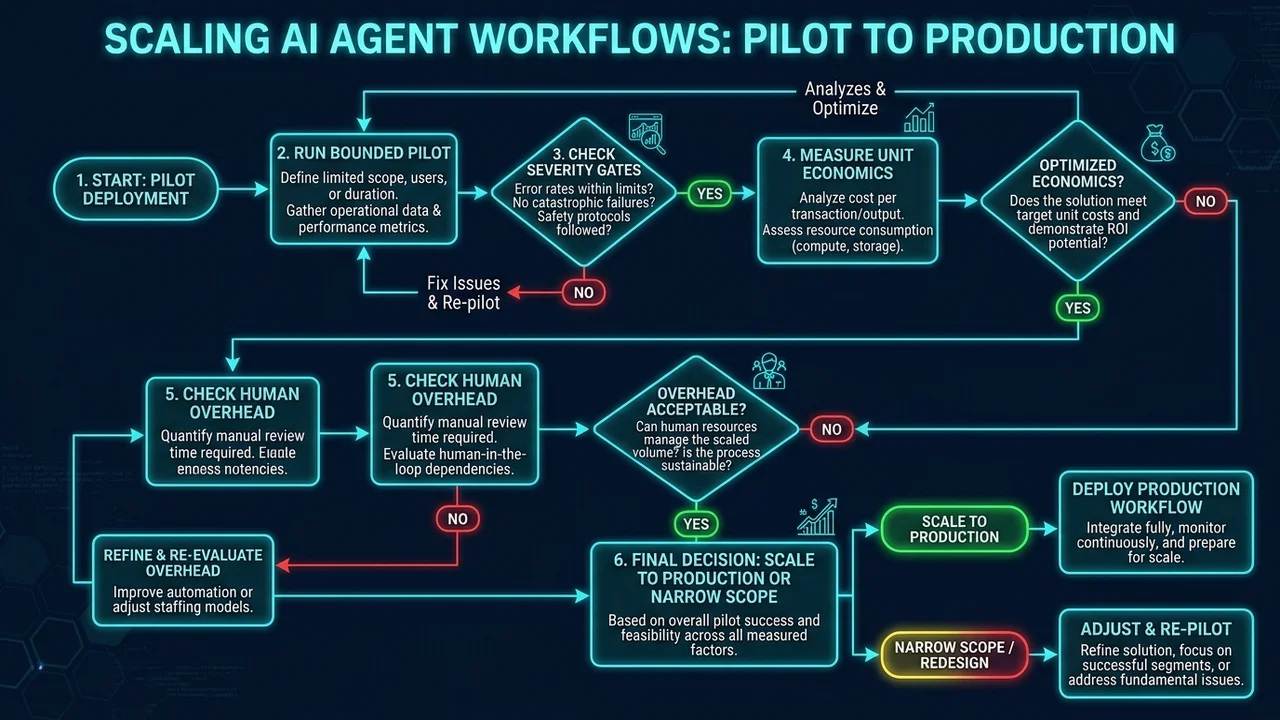 Figure 2: Governance decision tree: evaluating severity gates, true unit economics, and human overhead before granting workflows production scale.
Classify failures by their consequences. A formatting error that a reviewer catches is different from publishing an unsupported claim or writing to the wrong destination. A rare consequential error can matter more than many harmless formatting corrections.
Before running the pilot, identify which failures stop it immediately. Examples might include crossing the authorized action boundary or losing the ability to identify what was changed. Define those conditions for your actual task rather than copying a generic risk list.
Keep severity separate from the average quality score. A high acceptance percentage cannot justify ignoring a failure that invalidates the operating model. Narrow the scope or improve the control before collecting more volume.
Calculate the cost of accepted work
Include model usage, tool charges, allocated infrastructure, and active human time. Record setup effort separately and explain how you allocate it. A pilot with substantial custom preparation may still be worthwhile, but that work should not disappear from the comparison.
Consider a hypothetical batch of twenty tasks: fifteen pass, three need correction, and two are rejected. If the corrected tasks eventually pass, record seventeen accepted tasks and preserve the correction time. If the full batch costs $85, the cost per accepted task is $5. This is an illustrative calculation, not a typical agent cost.
If the baseline costs less but requires more elapsed time, decide whether the speed difference matters. Some workflows benefit from overnight preparation; others need immediate interaction. Make the trade-off explicit instead of treating automation itself as the benefit.
Record intervention without punishing appropriate escalation
Distinguish an expected clarification from an avoidable rescue. Asking for a missing destination can be correct behavior. Requiring a human to recover a lost artifact after every run is a process defect. Both involve a person, but they imply different changes.
Use reason codes such as missing input, unsupported claim, tool failure, invalid format, wrong scope, and reviewer preference. After the pilot, inspect the most frequent categories. You may discover that the brief needs improvement rather than the model.
The silent automation failure case study is relevant here: a system that appears active can still fail to produce expected work. Your scorecard should verify the output’s existence and acceptance, not merely successful execution logs.
Test recovery before increasing volume
Interrupt a controlled test between steps and verify what happens on retry. Does the agent create a duplicate draft? Does it repeat an external action? Can the reviewer find the last durable state? A pilot should reveal those behaviors before the workflow becomes routine.
Store a stable task identifier and connect it to outputs and execution attempts. Keep enough safe diagnostic information to understand failures without logging secrets or unnecessary private content. The record should support troubleshooting and accountability, not become another uncontrolled data collection.
For orchestration-specific failure handling, n8n’s error workflow documentation describes how failed executions can route to an error workflow. That mechanism helps expose a failure; your acceptance checks still need to determine whether the task itself succeeded.
Make a bounded expansion decision
Choose among expanding the tested scope, extending the pilot, narrowing the task, or stopping. Record the evidence and remaining uncertainty. A successful draft-generation pilot does not authorize automated publishing, just as a successful read-only research pilot does not establish safe account modifications.
Compare new tasks with the conditions already tested. If inputs, permissions, or consequences change, treat that as another evaluation boundary. Growth in volume should follow evidence, not replace it.
Pilot checklist
- Define the task, output, and accepted completion condition.
- Bound permissions and consequential actions.
- Include routine, ambiguous, and failure cases.
- Preserve a baseline and held-out tasks.
- Count failures, retries, and human repair effort.
- Set stop conditions for consequential errors.
- Test recovery and duplicate prevention.
- Record the scope of the expansion decision.
Frequently Asked Questions
What acceptance rate is good enough?
It depends on the task and the consequences of failure. Define the requirement before the pilot and consider severity as well as frequency. A generic percentage is not a substitute for that judgment.
Does asking for help mean the agent failed?
Not necessarily. Correctly identifying missing information can be the expected outcome. Record whether the intervention was appropriate and whether the original task specification anticipated it.
Can a short pilot prove reliability?
It can support a limited decision and expose failure modes. It cannot establish performance across every future input or operating condition. Preserve the pilot’s scope in the conclusion.
Should I compare models or workflows?
For an operating decision, compare the complete workflows, including instructions, tools, review, and recovery. A model-only comparison may be useful later if the surrounding process is controlled.
Expand the work you can actually verify
Use the n8n program page to explore orchestration options, and the AI tool evaluation scorecard for a narrower product comparison. Keep the agent pilot focused on accepted work under known conditions.